
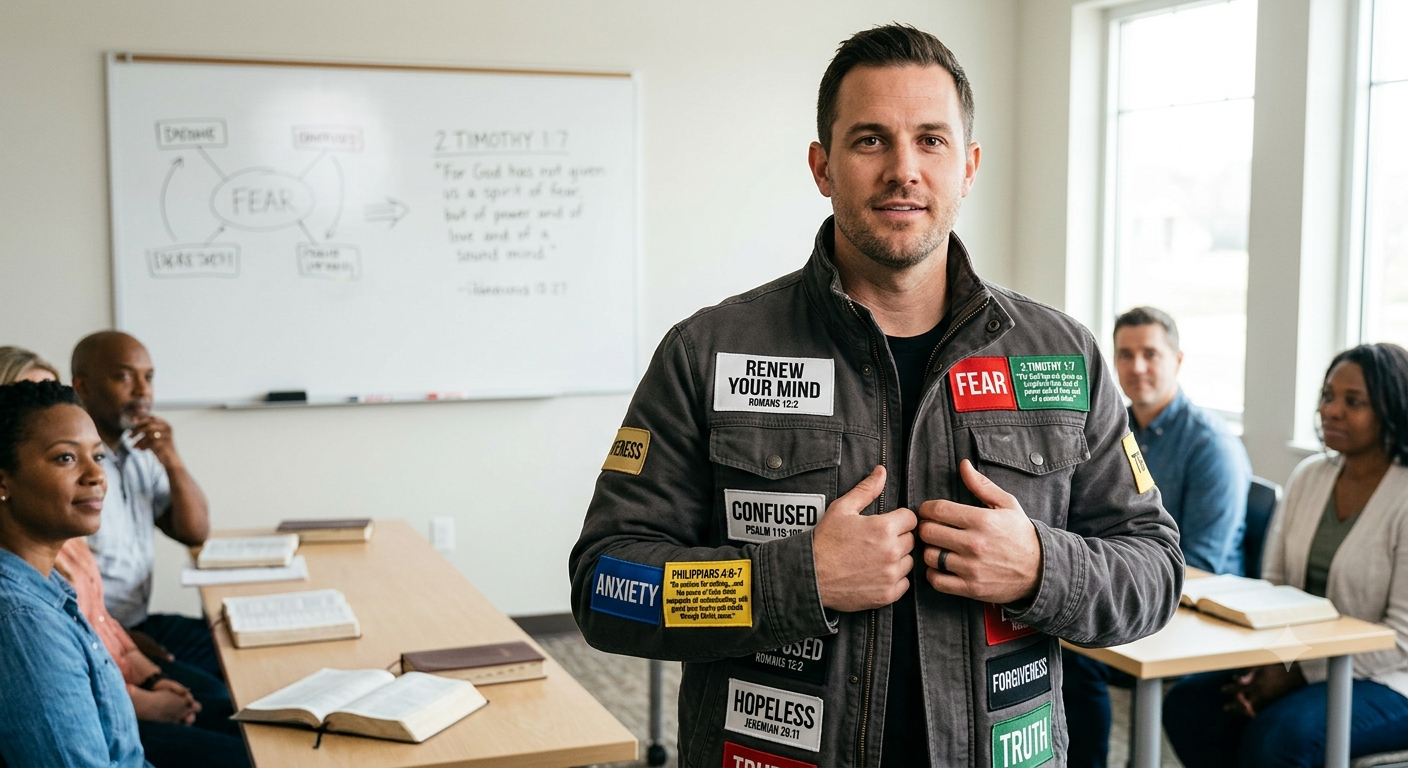
“And do not be conformed to this world, but be transformed by the renewing of your mind, that you may prove what is that good and acceptable and perfect will of God.” Romans 12:2
Pulpits frequently talk about renewing your mind like it’s a sudden, mystical experience or a vague command to just think about God more. But in daily life, that’s not how it works. Your mind changes through steady discipline and daily practice, step by step, because habits are formed by what you repeatedly do. You don’t change your heart with vague, good intentions. You change it by catching a specific false pattern—a lie, a fear, or a bad habit—and replacing it with a specific truth, over and over, until the new way becomes second nature.
Hebrews points right to this when it speaks of those who, “by reason of use, have their senses exercised to discern both good and evil” (Hebrew 5:14). Growth takes practice.
When a sermon simply tells you to “let God renew your mind today,” it leaves you without a clear pattern to follow. The human heart is shaped by what it actually thinks and does every day. Telling someone who is anxious that “God loves you, so stop worrying” doesn’t give them anything to hold onto when panic wakes them up at two in the morning. A deliberate approach works differently. When financial panic hits, you stop and recognize the real issue: you’re believing the lie that you are on your own without a provider. You replace that specific fear with Philippians 4:19, and you practice leaning on God’s track record. That is how real, lasting change happens.
The Bible models this exact approach in 2 Corinthians 10:5 when it tells us to take “every thought” captive to make it obedient to Christ. Notice the focus is on individual, specific thoughts—not broad, floating moods.
Paul walks us through this exact pattern in Ephesians 4. He doesn’t just tell people to stop doing wrong; he pairs every old habit with a renewed mindset and a concrete action. In verse 25, lying isn’t just stopped; it’s put off and replaced with speaking the truth, because we belong to one another. In verses 26 and 27, uncontrolled anger is handled by refusing to let the sun go down on your wrath, dealing with the conflict before it can fester. In verse 28, stealing is exchanged for working with your hands so you can turn around and give to someone in need. You don’t just try to stop a bad behavior; you locate the root problem, bring God’s truth right to that spot, and lock it in with a new action.
If you want to see real transformation in your life, it comes down to a simple four-step pattern:
First, name the moment. Catch the exact thought when it happens—like the panic that everything will fall apart if you aren’t in total control.
Second, uncover the lie. Ask yourself what you are believing in that moment that contradicts what God says.
Third, bring the right scripture. Find the specific passage or truth that answers that exact lie, whether that’s Proverbs 3:5–6 or Isaiah 26:3.
Fourth, practice the swap. Every single time that thought comes back, intentionally speak and act on the new truth until it becomes second nature.
Real transformation doesn’t happen in the clouds of good intentions. It happens in the daily grind of specific, repeated choices.
Author

kay.alli@legalview.co.uk
Related posts
Purpose doesn’t retire!
- 0
- 1,072 words
“Now there was one, Anna, a prophetess, the daughter of Phanuel, of the tribe of Asher. She was of a great age…...
Read out all
Scapegoat
- 0
- 626 words
Yesterday we see the legal verdict that flows from Christ’s work: (Romans 5:1, Colossians 2:14 and Romans 8:1-2) our debt is cancelledwe...
Read out all
Justified through faith
- 0
- 411 words
“Therefore, since we have been justified through faith, we have peace with God through our Lord Jesus Christ.” Romans 5:1 Christ paid...
Read out allpoint of view
- 0
- 772 words
“So from now on we regard no one from a worldly point of view. Though we once regarded Christ in this way,...
Read out allLove reset!
- 0
- 573 words
“Righteousness and justice are the foundation of your throne; love and faithfulness go before you.” Psalm 89:14 This is how God rules,...
Read out allGive thanks in all circumstances.
- 0
- 349 words
“Give thanks in all circumstances; for this is God’s will for you in Christ Jesus.” 1 Thess 5:18 In the middle of...
Read out all